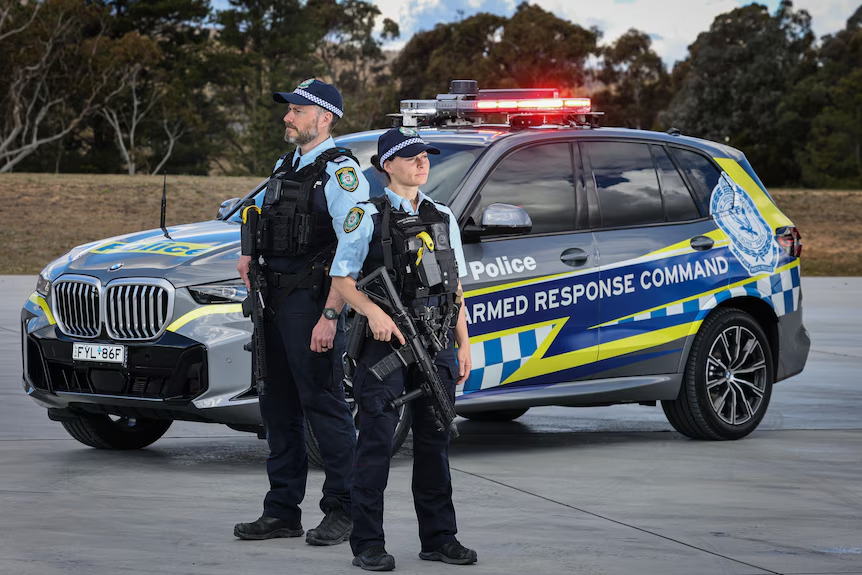
On Sunday 1 November, NSW Police’s new Armed Response Command began patrolling Sydney with long-armed rifles. The unit was born from the Bondi terror attack last December. It is funded with $94.3 million, and its first 60 officers are already on the streets, with the unit set to reach 250.
It will initially operate alongside Operation Shelter, which responds to antisemitic and Islamophobic incidents, gradually assuming its patrol responsibilities as the existing operation scales down.
The Bondi attack was an atrocity, and Australians of every faith, Muslims included, grieved for the victims and their families.
The NSW Government had to act. But we ask, did it act wisely?
Many in the Jewish community say it did. Alex Ryvchin, co-chief executive of the Executive Council of Australian Jewry, told SBS News on 1 November that police at Bondi were not given the means to stop the attack quickly. He acknowledged that no Australian wants military weapons on the streets, but said “the sight of body bags is far worse”.
We understand that grief and that fear. But we, and many others, are not convinced this unit is the right answer.
Greens MLC Sue Higginson calls the new squad an “intimidation unit”. Even Premier Chris Minns acknowledges it is “not necessarily normal to see heavily-armed police officers on our streets”.
Timothy Roberts, President of the NSW Council for Civil Liberties, told The Guardian newspaper that we are witnessing an “American-style militarisation of our police force”. He says it is a move away from community-led policing that increases the risk of state violence.



Amnesty International Australia shares those fears. It has raised “serious concerns about the increasing militarisation of policing”. It wants the government to guarantee that the unit will not be used to intimidate or suppress peaceful protest.
We believe rifle-armed patrols in crowded public places are dangerous and the case for them hasn’t been made.
Overseas experience shows the risk. In 2012, two New York police officers confronted a gunman outside the Empire State Building and fired 16 rounds. All nine bystanders wounded that day were hit by police bullets, fragments or ricochets. An analysis of NYPD records found that officers hit their targets with only 30 per cent of shots fired when suspects did not return fire, falling to 18 per cent during gunfights.
Those officers carried handguns. Rifle rounds travel further and hit harder, and on a crowded Sydney street the risk to innocent bystanders is real.
Police say the unit’s officers have completed six months of specialist training, and we do not doubt their professionalism. At the Royal Commission, NSW Police told the inquiry that the general-duties officers who confronted the Bondi gunmen with pistols were outgunned. Two were seriously injured. Commissioner Mal Lanyon has praised those officers, saying they “did a wonderful job to resolve that situation”.
Police argue the new unit will deter attackers and reassure the public. But faster access to rifles when a threat emerges is one thing. Permanent rifle patrols through crowded public spaces are another. Sydneysiders deserve to know what the second will add, and at what risk.
Commissioner Lanyon says he does not envisage the unit being deployed at protests, and we welcome that.
But the unit’s own commander, Detective Superintendent Andrew Evans, says he is “not in a position to say we will never be there”. Because the unit inherits Operation Shelter’s patrols, any promise must be written into the unit’s deployment rules.
The Council for Civil Liberties agrees: it says a verbal assurance is not enough, and that keeping rifle-carrying officers away from protests must be set down in policy and legislation.
Yet Police Minister Yasmin Catley has said the government will “absolutely not” regulate where the unit can be deployed. A promise that cannot be checked is hardly a safeguard.
After all, peaceful protests are not a threat.
When 300,000 people of all faiths and no faith marched across the Harbour Bridge for Gaza in August last year, there were no arrests reported.
The vast majority of protests and community events pass peacefully. Why police them as if they are a terror threat?
The government says the unit is intended to protect everyone, including worshippers at mosques. But we do not want these dangerous weapons brought to our places of worship. Mosques should be places of prayer and peace, not locations for rifle-armed police.
Security at places of worship is important, but it must be proportionate to genuine risk, not political pressure. No community should be expected to accept a level of armed policing that it believes is unnecessary or dangerous.
(Feature image supplied, NSW Police).