Late last week, within hours of each other, two acts of terror shocked communities half a world apart.
On Friday morning in Trappes, a working-class town west of Paris, a gunman drove through the streets firing an automatic weapon at people going about their day. One man of African origin was killed and five others were wounded, among them a 12-year-old girl who was shot eight times.
President Emmanuel Macron called it a terrorist and racist attack and said the victims were targeted for their religion and the colour of their skin. The town’s mayor described it as probably Islamophobic. The 39-year-old suspect has denied any racist motive.
That same afternoon in the village of Hmoud near Karak in southern Jordan, three gunmen opened fire on mourners at a funeral at St George’s Greek Orthodox Church. Nine people were killed and dozens wounded.
On Monday Jordanian police arrested two brothers and their brother-in-law, whom authorities have called extremist terrorists.Jordan’s prime minister said the attack was a result of terrorist ideology and blind extremism. King Abdullah visited the wounded and the nation observed three days of mourning.
Meanwhile in southern Lebanon, a slower kind of violence keeps on keeping on. Israel’s occupation, carried out in the name of fighting Hezbollah, has driven more than a million Lebanese from their homes.


This month Israel’s defence minister boasted that around 60 villages have been destroyed, and residents are barred from going back. Families with no connection to any armed group have lost their houses, their orchards and the graves of their parents.
By Israel’s own count, some 23,000 buildings have been destroyed, and hundreds of thousands of ordinary people, most of them with no link to any armed group, still cannot go home.
Three very different events but there’s a common thread.
We believe the lesson is that extremism comes in every shape, colour and size. It’s not owned by any one faith or people.
A gunman in a French suburb, gunmen who turned a Christian funeral into a massacre and a military that flattens whole villages and empties a region of its people are all symptoms of the same sickness: the refusal to see the other as fully human.
That is why it is so wrong, and so useless, to pin terrorism on one community.
Muslims know this better than most. For decades we have been asked to answer for crimes committed by people who share our faith but not our values.
We will not turn around now and blame Jews everywhere for the conduct of the Israeli government, or blame Christians for the hatred of a French gunman.
A wrong is a wrong whoever commits it. People of conscience must be willing to call it out on ethics and morality alone, with no exemptions for their own side.
Extremism grows when intolerance is allowed to grow. It feeds on short attention spans, on a lack of curiosity about other cultures and on public figures who profit from fear.
The likes of Tommy Robinson in Britain and, closer to home, Pauline Hanson, have built platforms and careers by stoking suspicion of whole communities.
Hate for hate’s sake earns them headlines, notoriety and a seat at the table.
We should not be surprised when the words of the most vocal become the actions of the most unhinged.
So yes, there must be zero tolerance for terrorism.
But there must also be zero tolerance for those who keep pouring fuel on the fire./
Social media platforms, mainstream outlets and every one of us share that obligation to step back and show some respect.
For Muslims the guide is clear. The Prophet, peace be upon him, taught by example, and the Qur’an tells us there is no compulsion in religion.
Respect for other faiths and peoples is not a modern add-on to Islam. It sits at its heart.
We will keep saying so, and we doubt any fair-minded Australian, Muslim or not, could argue against it.
If we as a society do not start closing the gaps between our communities, we will keep counting the dead. We cannot allow that to happen.
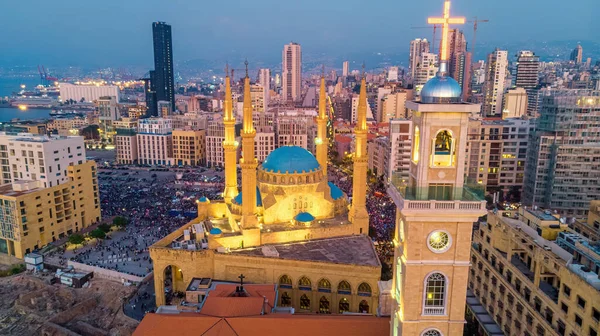
- Feature image: Side by side in downtown Beirut, the Mohammad Al-Amin Mosque and St George Maronite Cathedral are a reminder that faiths can share the same ground.