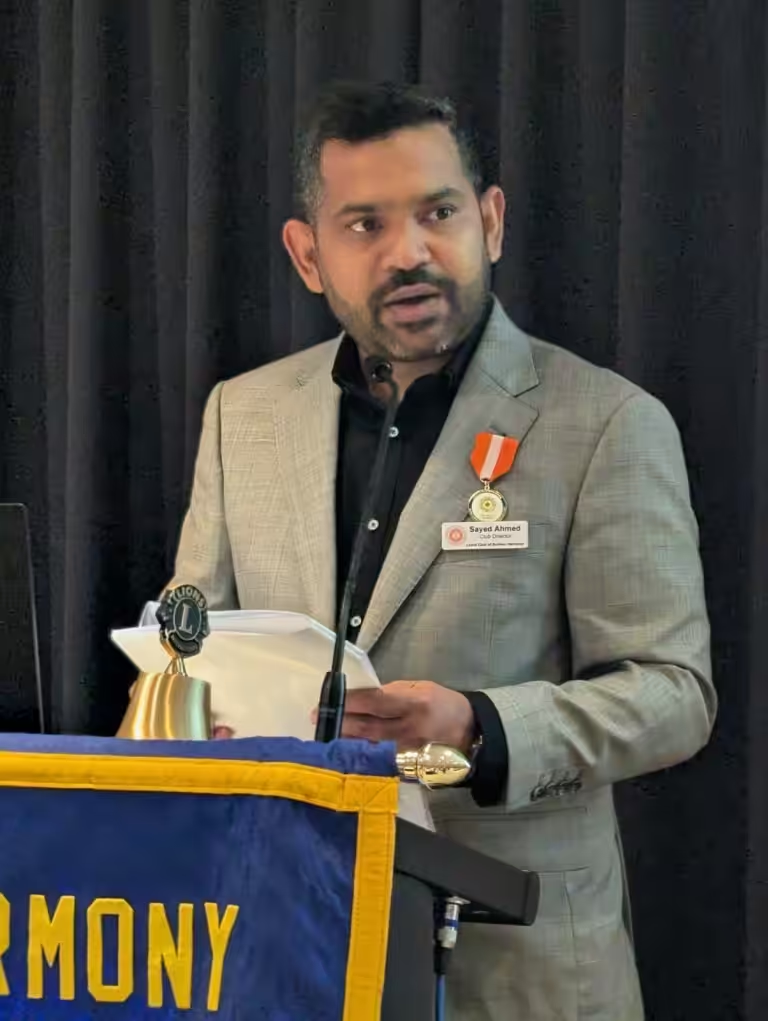
From a village in Bangladesh to Australia’s first PhD in pedorthics, Dr Sayed Ahmed has become a leading voice in diabetic foot care and a source of pride and inspiration for Sydney’s Muslim community.
In February 2024, Dr Ahmed crossed the stage at a Southern Cross University graduation ceremony on the Gold Coast and became the first pedorthist in Australia to be awarded a Doctor of Philosophy.
It is worth contemplating what that really means.
Most doctoral candidates walk a well-trodden path, guided by supervisors who have already earned the same qualification in the same field.
Dr Ahmed had no such road map.
Australia had highly skilled and experienced pedorthists, and he learned a great deal from them, but none held a PhD in the discipline.
That meant no one could show him from their own experience what doctoral research in pedorthics looked like.
He had to shape that path himself, combining the practical wisdom of his pedorthic mentors with academic guidance from related fields, and in doing so, he set the standard others will now follow.
Being first means building the road while you travel it.
Pedorthics….many readers will not have heard the word.
It is the practice of assessing, designing, making and modifying footwear and orthotic devices to support conditions affecting the foot, ankle and lower leg.
Pedorthics draws on biomechanical analysis and uses therapeutic shoes, custom orthoses and shoe modifications to improve mobility, ease pain and prevent or manage foot problems.

(left) with other medical experts at the International Forum of Advancements in Health Care (IFAH)
in Las Vegas
This work is vitally important for people with diabetes.


Diabetes can cause nerve damage, poor circulation and foot ulcers, and in the worst cases these complications lead to amputation.
Dr Ahmed’s doctoral research tackled this head on: his thesis examined footwear and insole prescription for people with diabetes and neuropathy at high risk of forefoot ulcers, aiming to develop design principles that prevent those ulcers.
He is also exploring how artificial intelligence can personalise device prescriptions to improve patient outcomes.
Born in a small village in Bangladesh, Sayed grew up inspired by his father, who was known for his integrity and service to the community.
He studied footwear technology at the University of Dhaka, worked in the footwear industry and then completed an MBA.
In 2009, he came to Australia as a skilled migrant and completed the training required to become a registered pedorthist.
Back home, his doctorate made headlines: the achievement earned front-page coverage in Prothom Alo, the most widely read daily newspaper in a country of 177 million!
Today, he is the founder and CEO of both OrthoGenix and Foot Balance Technology, where he is leading work in digital health and AI to create more accurate footwear and orthotic solutions.
He runs clinics in Castle Hill, Westmead and Campbelltown, supports high-risk foot clinics at several major hospitals and contributes to national standards through the Foot Network Working Party.
International recognition has followed.
He was named among the Top 100 Healthcare Leaders in Las Vegas in 2019 and received an Outstanding Leadership Award at the Health 2.0 Conference in Dubai in 2022.
He has regularly been a featured speaker at major conferences and congresses, both locally and internationally.
For all his accolades, Dr Ahmed is quick to name what grounds him.
Living and working in the Hills district, he regularly attends his local masjid and makes time for the community despite a demanding schedule.
Asked about his success, he gives the credit elsewhere: “None of this would be possible without Allah’s guidance.”
He also credits his first mentor in pedorthics, Sydney foot health professional Karl-Heinz Schott, and now sees guiding the next generation as his own duty.
That sense of duty is on full display in his community health work.
He chaired last year’s Diabetes Awareness Forum at Wenty Leagues Club in Western Sydney, organised by the Sydney Harmony Lions Club, drawing more than 200 people including health professionals, Lions members, patients and the general public.
For Dr Ahmed, the value of such events lies in “breaking down barriers between medical professionals and the public.”
The need is real. Figures from the Western Sydney Diabetes Initiative show that one in three adults in Western Sydney is at risk of type 2 diabetes.
The Sydney Harmony Lions Club has honoured Dr Ahmed for his contributions to diabetes awareness, and he has expressed interest in working with the Lebanese Muslim Association to bring a diabetes forum to Lakemba.
Now 17 years after arriving in Australia, he remains grateful for the opportunities his adopted home has given him to pursue his passion for healthcare and give back to the community.
Dr Sayed Ahmed’s story is one that Sydney’s Muslim community should hold up with real pride.
He is a migrant who arrived with a vision, a practising Muslim who keeps his faith at the centre of his life, and a scientist who went where no Australian in his field had gone before.
His work is protecting people from pain, disability and amputation – and his commitment to mentoring – means the path he built will be easier for those who follow.
That is a legacy worth celebrating.